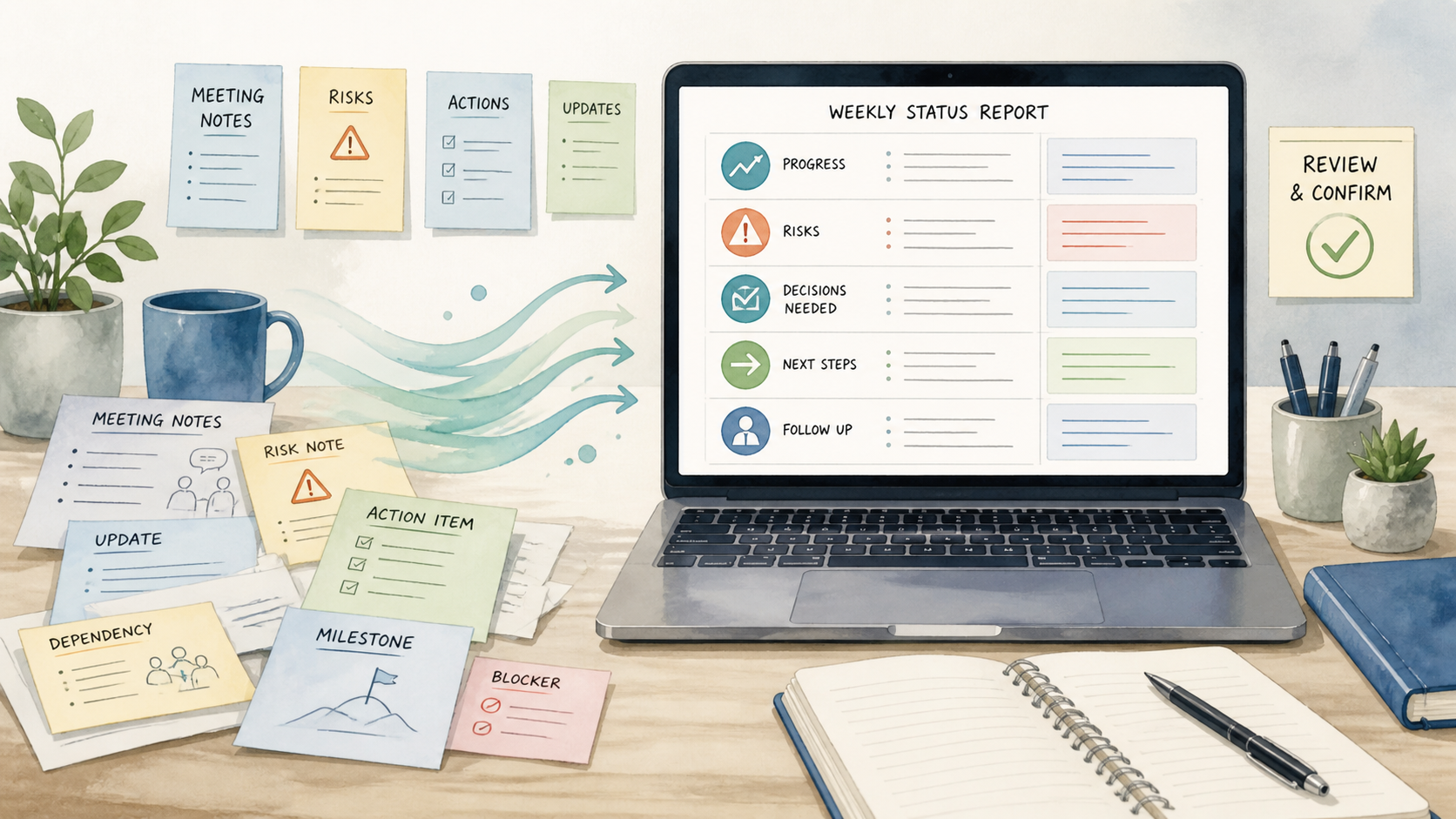
A project can have plenty of updates and still leave leaders unsure about what is happening.
One person reports that testing is “nearly complete”. Another says a dependency is “being worked through”. The project plan shows a milestone in two weeks, while the meeting notes mention a delay that has not reached the risk register. By Friday, the project manager has several versions of the truth and a blank status-report template.
This is a good use for workplace AI, but only if AI is treated as a drafting assistant, not the owner of the project story.
The aim is not to make reporting sound more polished. It is to turn scattered evidence into a short, decision-ready update that a responsible person checks and approves.
Why This Problem Matters
A status report should help its audience understand the project’s position and act where needed. Public project-status guidance commonly treats status reporting as a way to make progress visible, communicate project health, and surface risks, issues and action items, rather than simply listing weekly activity.
That distinction matters. A long report can be accurate but still unhelpful. A neat green dashboard can hide a milestone that is about to slip. A list of completed tasks can distract from the one unresolved decision blocking the team.
The problem becomes harder when information is spread across tools and written at different levels of detail. Project managers spend time collecting, cleaning and rewriting updates, then trying to decide what matters to each audience.
AI can reduce the rewriting effort. It can group similar points, identify possible contradictions, convert notes into a consistent structure and draft plain-language summaries. It cannot decide whether a risk rating is honest, whether an assurance statement is justified or whether sensitive information is appropriate to share. Those remain human responsibilities.
The Simple Concept: Evidence First, Judgement Last
Use AI between two human-controlled stages:
Source evidence → AI-assisted structure and draft → Human verification and approval
The first stage protects the quality of the inputs. The final stage protects the meaning, accountability and decision.
This approach aligns with Australia’s AI Ethics Principles, which emphasise privacy, reliability, transparency and accountability. The Office of the Australian Information Commissioner also recommends due diligence, privacy by design, human oversight and ongoing review when organisations use commercial AI products.
In practical terms: use only an organisation-approved AI tool; provide the minimum information required; ask the tool to distinguish fact from uncertainty; and make a named person responsible for the final report.
A Six-Step Workflow for a Better Weekly Status Report
Step 1: Define the Decision Audience
Before collecting updates, write one sentence:
“This report helps [audience] understand [project position] and decide or support [required action].”
For example:
“This report helps the steering committee understand delivery confidence and resolve decisions that the project team cannot make alone.”
This prevents the report from becoming a diary. A delivery team may need detailed actions and owners. An executive group may need milestone confidence, material risk, budget position and decisions required. One source set can support both, but the outputs should not be identical.
Step 2: Collect a Small, Controlled Source Pack
Bring together the evidence needed for this reporting period. Depending on the project, that might include:
- the approved plan or milestone tracker
- the current risk and issue register
- agreed actions and decisions
- brief workstream updates
- confirmed budget or resource information
- the previous status report
Do not paste an entire mailbox or chat history into an AI tool. Remove duplication and exclude personal, sensitive, confidential or patient-related information unless your organisation has explicitly approved the tool and use case for that data.
For healthcare settings, use de-identified operational information wherever possible. This article is about project delivery and service operations, not clinical decision-making.
Step 3: Use a Fixed Reporting Structure
Give the AI a consistent destination. A useful weekly structure is:
- Overall status and reason
- What changed this period
- Milestones and forecast
- Top risks and issues
- Decisions or support required
- Priorities before the next report
Consistency makes reports easier to scan and compare. It also reduces the chance that the AI decides what the format should be each week.
Step 4: Give the AI Clear Instructions and Boundaries
OpenAI’s prompting guidance recommends making the goal, context, required output and boundaries clear. A reusable instruction could be:
“Using only the source material below, draft a weekly project status report for the steering committee. Use the six-section structure provided. Separate confirmed facts from assumptions. Do not invent dates, percentages, owners, causes or decisions. If evidence conflicts or is missing, write ‘Needs verification’ and list the specific gap. Keep the report under 500 words. Use plain Australian English. Do not include personal, patient or commercially sensitive details.”
Then place the approved source material under a clear heading.
The most important instruction is “using only the source material”. The second is to surface gaps instead of smoothing them over. A confident sentence built on weak evidence is worse than a visible question.
Step 5: Run a Human Decision Check
Review the draft using five questions:
- Is every status claim supported by a current source?
- Are dates, figures, owners and risk ratings correct?
- Does the report clearly say what changed?
- Is each requested decision specific, owned and time-bound?
- Could any sentence expose information that should not be shared?
Check the underlying project systems, not just the AI’s summary. If the draft says a milestone remains on track, compare that claim with dependencies, current progress and the approved baseline. If two sources disagree, resolve or disclose the conflict.
The report owner should also check tone. “Minor delay” may sound reassuring, but it is not useful unless the impact and recovery plan are clear.
Step 6: Approve, Send and Improve the Template
A responsible person approves the report before distribution. If AI materially assisted the draft, follow your organisation’s disclosure and record-keeping rules.
After sending, note what readers asked. If leaders repeatedly ask for the same missing information, change the template or source-collection process. The goal is not a clever prompt. It is a dependable reporting workflow.
A Realistic Workplace Example
Imagine a fictional digital scheduling project across several service sites.
The weekly inputs say:
- Configuration is complete.
- User testing is 70 per cent complete.
- Two sites have not confirmed training dates.
- The planned pilot starts in three weeks.
- A workstream lead says the pilot is “still achievable”.
- The risk register has not been updated for ten days.
A weak AI instruction might produce: “The project remains on track, with testing progressing well and training being coordinated.”
That sounds professional, but it hides uncertainty.
A stronger workflow produces:
“Overall status: Amber, needs verification. Configuration is complete and user testing is reported at 70 per cent. Training dates remain unconfirmed for two sites. The effect on pilot readiness has not been assessed in the current risk register. Decision required: confirm whether the pilot date remains achievable after site training dates and readiness criteria are validated.”
The better version does not pretend to know the answer. It shows what is known, what is missing and what needs to happen next.
Common Mistakes and Risks
Treating AI as the source. AI should summarise approved evidence, not replace the plan, register or accountable owner.
Pasting too much information. More text does not guarantee a better report. It can increase privacy risk and make contradictions harder to detect.
Asking for polish before accuracy. A fluent rewrite can conceal weak evidence. Request gaps, conflicts and unsupported claims first.
Using traffic-light status without reasons. Red, amber and green are only useful when the basis and trend are clear.
Letting AI invent precision. Dates, percentages, owners and financial figures must come from verified sources.
Removing human accountability. The person approving the report remains responsible for its accuracy, appropriateness and message.
Try This This Week
Choose one existing weekly report and run a small, low-risk trial:
- Use an approved AI tool.
- Remove personal and sensitive information.
- Provide only the current report, verified updates and reporting structure.
- Use the instruction above.
- Compare the draft against every source.
- Record one improvement and one risk before deciding whether to repeat the workflow.
Do not measure success by how quickly the AI creates a draft. Measure whether the final report is clearer, easier to verify and more useful for decisions.
Key Takeaway
AI can help turn scattered project updates into a consistent status-report draft. The value comes from the workflow around it: controlled sources, a fixed structure, explicit boundaries and a human decision check.
Use AI to reduce formatting and rewriting. Keep evidence, judgement, privacy and accountability with people.
Connect with Raf on LinkedIn or follow rafsanga.com for more practical guidance on AI, project management and continuous improvement.
AI disclosure: AI tools assisted with research and drafting. The final article was reviewed and approved by the author.
Comments
Post a Comment